Skip to content
The Things Stack documentation home
Getting Started Concepts Cloud Enterprise Integrations API Hardware
Getting Started Concepts
Cloud Enterprise
Integrations API Hardware
Get The Things Stack

    Recent searches

      Popular pages

      • Getting Started
      • Adding Gateways
      • Adding Devices
      • Payload Formatters
      • Webhooks
      • Authentication

      No results for “”.

      • Check the spelling, or try fewer or more general words.
      • Ask the community on The Things Network Forum
      • Contact support
      ↑↓ to navigate ↵ to open Esc to close

      Hardware

      • Overview
      • Devices
      • Gateways
        • Concepts
        • Models
          • Building a gateway with Raspberry Pi and IC880A
          • Browan Minihub Pro
          • Cisco IXM Wireless Gateway for LoRaWAN
          • CloudGate
          • COTX
          • Dragino LPS8N
            • Connect Dragino LPS8N with Lora Basics™ Station
            • Connect Dragino LPS8N with UDP Packet Forwarder
          • Kerlink Wirnet iStation
          • Kerlink Wirnet Station
          • Laird Sentrius™ RG1xx LoRaWAN Gateway
          • MikroTik KNOT
          • MikroTik LtAP
          • MikroTik Routerboard wAP LoRa8 kit
          • Milesight UG56 LoRaWAN Gateway
          • Milesight UG65 LoRaWAN Gateway
          • Milesight UG67 LoRaWAN Gateway
          • Milesight UG85 LoRaWAN Gateway
          • Milesight UG87 LoRaWAN Gateway
          • MOKOSMART MKGW2-LW LoRaWAN® Gateway
          • MultiTech Conduit AEP
          • MultiTech Conduit mLinux
          • NASys LoRaWAN Outdoor Gateway
          • Peplink Balance 20X LoRaWAN (with FlexModule Mini)
          • RAK7240 WisGate Edge Prime
          • Robustel R1520LG
          • Tektelic Kona Micro IoT LoRaWAN Gateway
          • The Things Indoor Gateway
          • The Things Indoor Gateway Pro
          • The Things Kickstarter Gateway
          • The Things Outdoor Gateway
          • Wifx L1
          • Wifx LORIX One
        • Troubleshooting Gateways
      • Works with The Things Stack

      Connect Dragino LPS8N with Lora Basics™ Station

      Updated 8 November 2026 Edit on GitHub
      Copy page
      • View as MarkdownThis page as plain text
      • Open in ChatGPTAsk questions about this page
      • Open in ClaudeAsk questions about this page

      This section contains instructions for connecting the Dragino LPS8N LoRaWAN® gateway to The Things Stack using LoRa Basics™ Station.

      Registering Gateway

      In the The Things Stack console, go to the Gateways tab and click the Register Gateway button to register the gateway and make sure to select these three settings below:
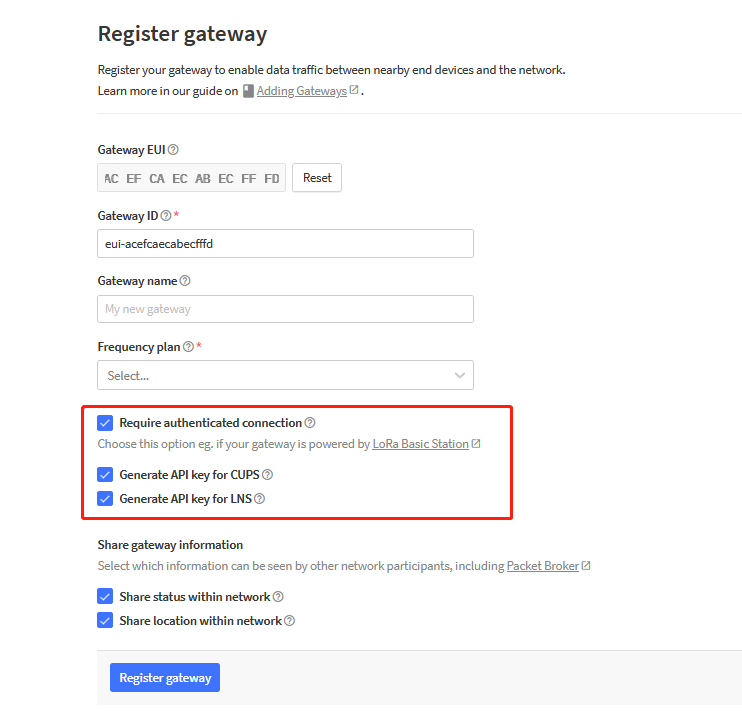
      Register gateway form in The Things Stack Console with Require authenticated connection and both API key options checked

      When the keys popup shows after registering, download the keys, and click I have downloaded the keys.
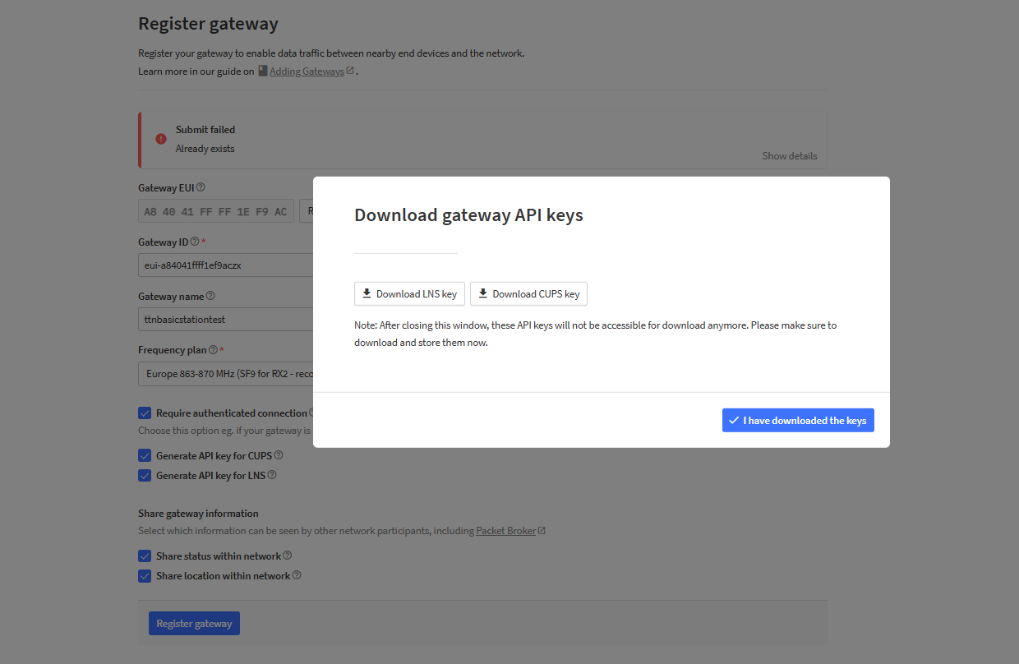
      Download gateway API keys dialog with buttons to download the LNS key and the CUPS key

      Note:

      If you have already registered your gateway and forgot to check the boxes, or if you have been using UDP and want to switch to LoRa Basics™ Station, create API keys manually.

      Configuring Gateway

      In the Gateway’s Web UI, navigate to LoRaWAN > LoRaWAN in the top menu.

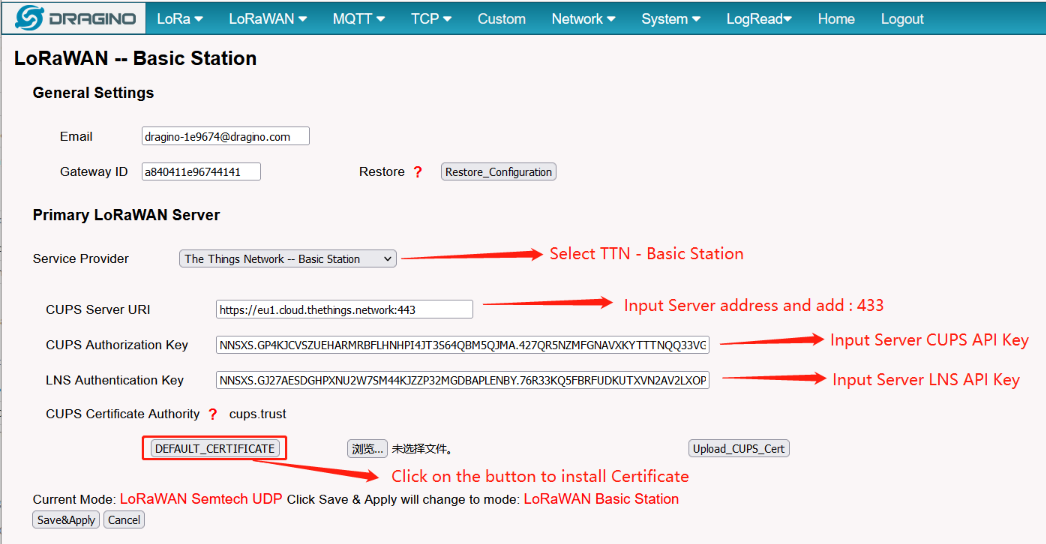
      On this page, configure the following settings:

      • Service Provider: The Things Network -- Basic Station
      • CUPS Server URI: The Things Stack server address with port 443 (e.g. https://eu1.cloud.thethings.network:443)
      • CUPS Authorization Key: The CUPS key you just downloaded.
      • LNS Authorization Key: The LNS key you just downloaded.
      • CUPS Certificate Authority: Install a certificate by clicking on the DEFAULT_CERTIFICATE button.

      Note: When entering the keys, the “Authorization: Bearer” field should not be entered in the TTN Basics Station configuration of the gateway.
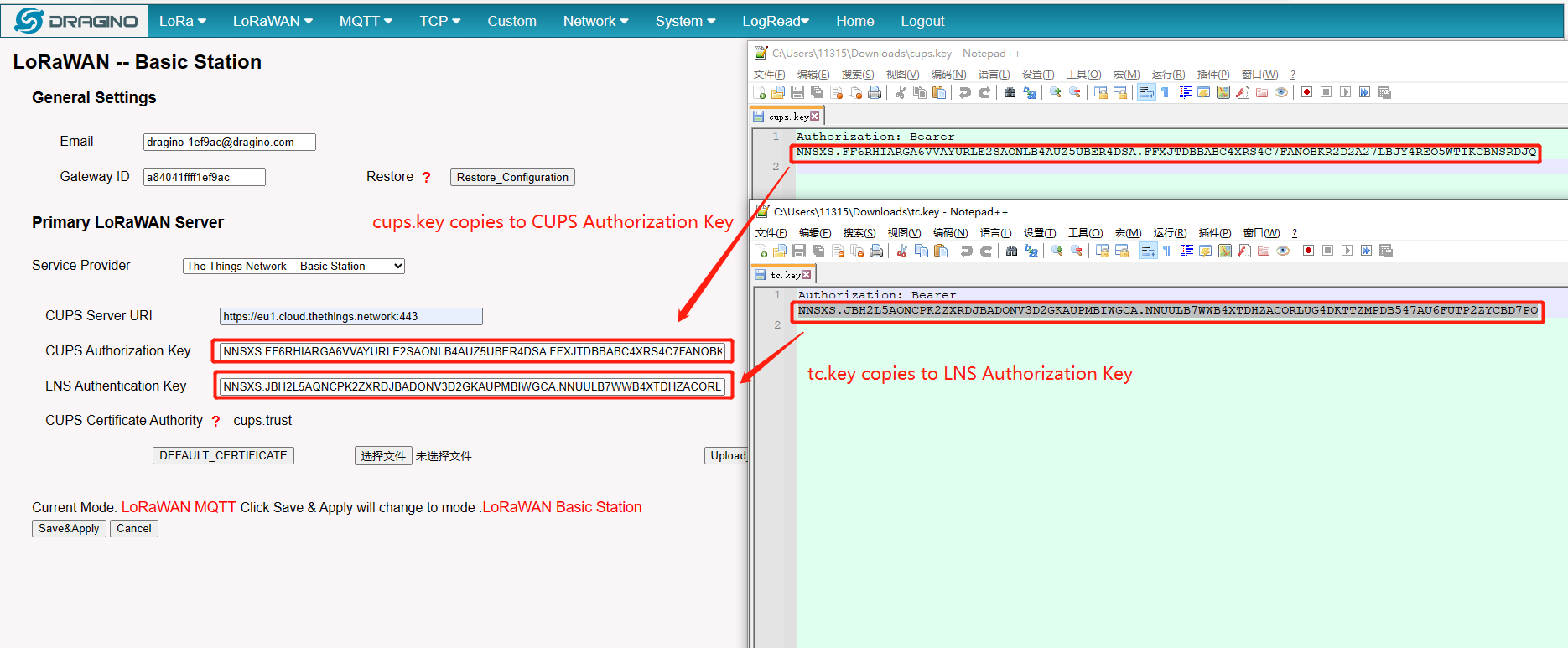
      Dragino LoRaWAN Basic Station settings: the downloaded CUPS and LNS keys pasted into the authorization key fields
      Dragino LoRaWAN Basic Station settings with the CUPS server URI, CUPS and LNS authorization keys and certificate filled in

      Once you’ve done all that, click Save & Apply.

      Finally, test your connection by going to the LPS8N’s Overview page. You should see the gateway status changed to connected (indicated by a blue dot) or observe the frequently updating Last seen time. Also, see the Live data section for various gateway related activities.
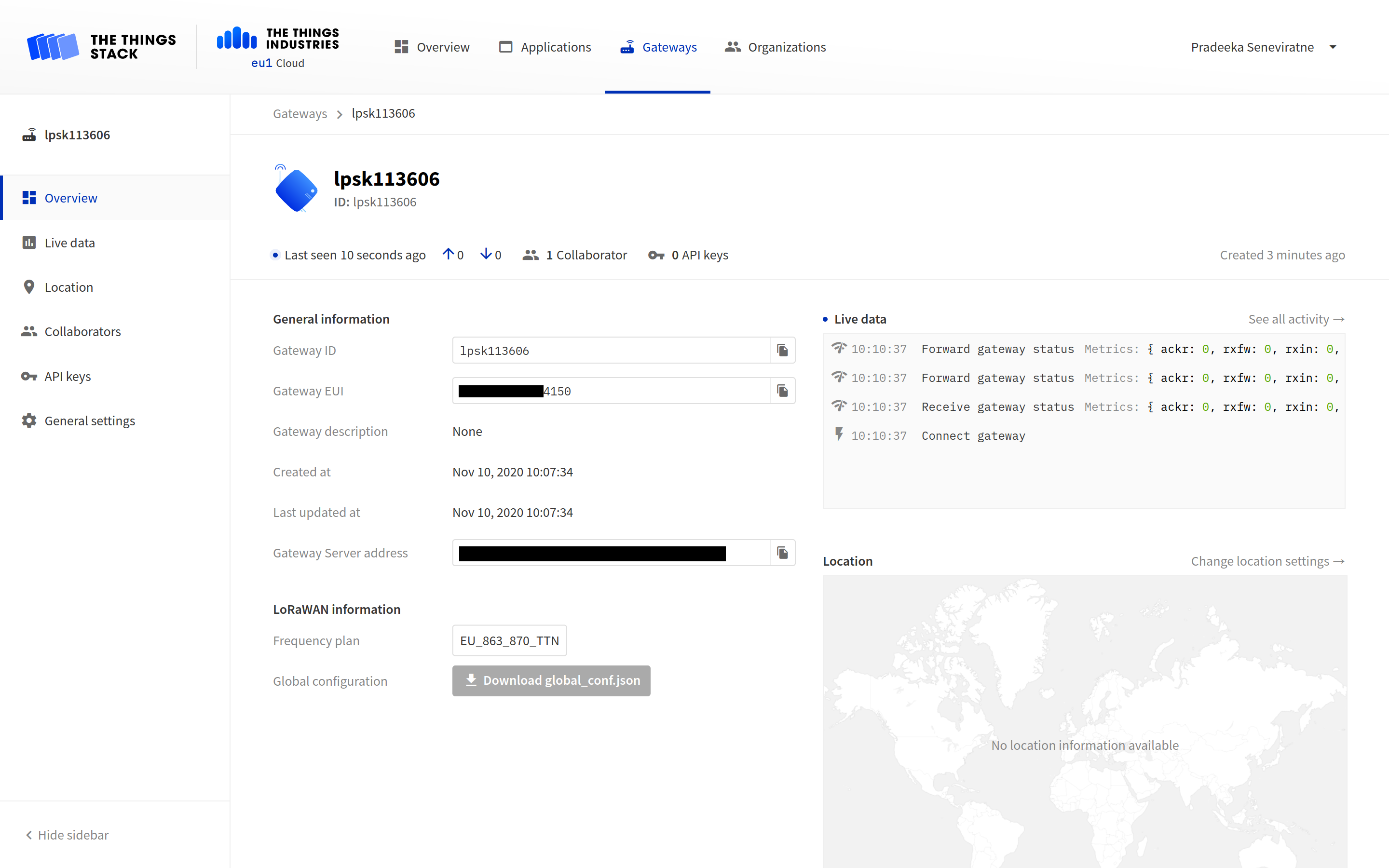
      Gateway add OK

      You can also verify the presence of a green tick on the LoRa icon in the Web UI.
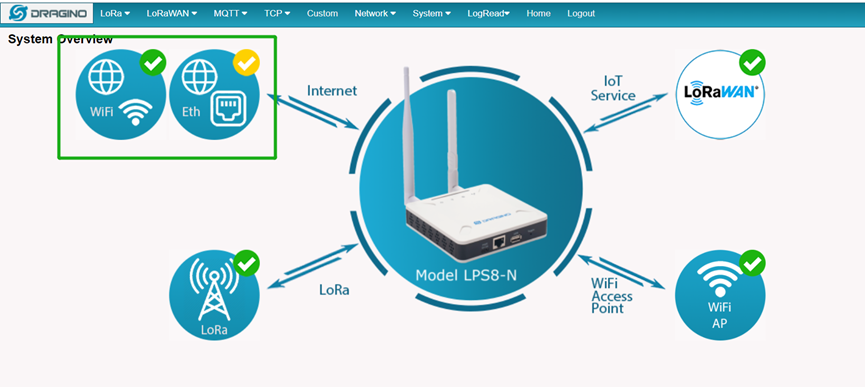
      LoRaWAN OK
      ← Dragino LPS8N Connect Dragino LPS8N with UDP Packet Forwarder →

      On this page

      • Registering Gateway

      Sections

      Getting Started

      Concepts

      Cloud

      Enterprise

      Integrations

      API

      Hardware

      Sitemap

      View our Sitemap

      Contributing

      GitHub

      About Us

      The Things Industries

      Privacy Policy

      Cookie settings

      Cookie Settings

      We use cookies to enhance your experience, analyze site traffic and deliver personalized content. Read our Privacy Policy.

      Cookie categories